

Chemical dosing in industrial water treatment is often described as a pump selection exercise. In practice, the pump is only one part of a controlled delivery system. The real engineering task is to place the correct mass of chemical into a changing water stream, safely and repeatably, despite variations in raw-water quality, production demand, ambient temperature, and operator attention. Those variations are familiar in Pakistan’s textile mills, cement plants, chemical facilities, and utility stations. A design that works only at one flow rate or with one freshly mixed tank will not remain dependable through a full operating season.
At Jams (Pvt.) Ltd, we begin with the process requirement rather than a catalogue model. Our water treatment and disinfection work covers the complete dosing point: chemical properties, storage and preparation, pump hydraulics, instrumentation, controls, injection, and maintainability. That approach prevents a common problem in which every individual item appears correctly specified, yet the assembled system cannot hold the required dose.
What a chemical dosing system must achieve
A dosing package converts a treatment target into controlled chemical flow. The target may be a chlorine residual, a coagulant dose in milligrams per litre, a pH band, a corrosion-inhibitor concentration, or an oxygen-scavenger ratio. The pump must supply the corresponding liquid volume, but it must also do so against the actual pressure at the injection point. Suction conditions, chemical concentration, solution ageing, pulsation, and the control signal all influence the result.
The first calculation is a mass balance. For a water flow expressed in cubic metres per hour and a required dose in milligrams per litre, the required active chemical mass can be calculated directly. That mass is then divided by the strength and density of the prepared solution to obtain litres per hour. The arithmetic is simple; the inputs are not. Commercial product strength is not always the same as active ingredient strength, and a prepared polymer or hypochlorite solution may change with time and temperature.
- Confirm minimum, normal, and maximum water flow instead of using only the design maximum.
- State whether the dose refers to commercial product, active ingredient, or prepared solution.
- Record operating pressure, static head, and possible transient pressure at the injection point.
- Define the required control mode: manual, flow-paced, batch, pulse, analogue, or feedback trim.
- Check wetted-material compatibility against the actual chemical concentration and temperature.
Why application conditions in Pakistan matter
Raw water can shift between bore, canal, municipal, and recovered sources. Conductivity, turbidity, hardness, and biological load may vary substantially, while production plants may operate at reduced flow during power or process interruptions. Outdoor chemical tanks face high summer temperatures. Dust affects vents, controls, and unprotected mechanical parts. A robust design therefore needs realistic turndown and environmental protection, not simply spare maximum capacity.
In textile utilities, dosing may support softening, reverse-osmosis pretreatment, cooling water, boiler feed, or effluent treatment. Cement sites add dust, long pipe routes, and demanding maintenance access. Chemical plants may require stronger compatibility checks and hazardous-area review. The same nominal flow can therefore lead to different pump, head, seal, enclosure, and control selections.
How we size and select the feed equipment
After calculating the theoretical requirement, we establish a useful operating range. A metering pump should normally run in a controllable portion of its capacity, with enough margin for process variation but without being so oversized that normal duty sits at the bottom of its adjustment range. The practical margin depends on how certain the process data is, how often solution strength changes, and whether a standby pump is installed. Arbitrary doubling of capacity is not sound engineering; it can reduce low-flow repeatability and make tuning difficult.
Pressure deserves equal attention. The selected pump must overcome injection-line pressure and losses, but pressure also helps the discharge valve seat consistently. Where system pressure is low or variable, a back-pressure valve may be required. Where the discharge could siphon into a lower point, an anti-siphon arrangement is essential. Long lines and larger pumps may require a pulsation dampener. The motor-driven metering pump range is relevant for many continuous industrial duties, but the correct configuration still depends on the hydraulic system around it.
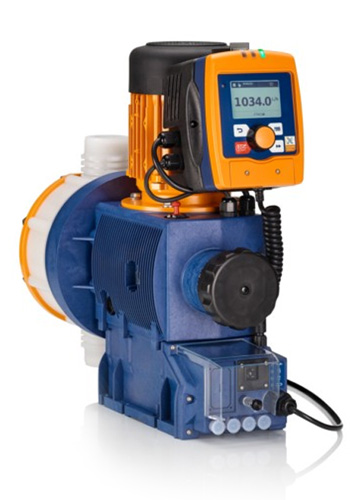
Materials and chemical behaviour
A generic label such as “acid” or “chlorine” is insufficient for materials selection. We need the exact chemical name, concentration, expected temperature, contaminants, and cleaning procedure. Sodium hypochlorite can release gas and lose strength, so suction layout and degassing behaviour matter. Concentrated acids can generate heat when diluted. Polymer solutions can be viscous and shear-sensitive. Slurries may settle or abrade valves. Compatibility tables are a starting point, but the complete application must be reviewed before confirming the liquid end, valve design, tubing, gaskets, and injection fitting.
Suction arrangement and accessories
Many apparent pump faults begin on the suction side. Excessive lift, narrow tubing, clogged foot valves, air leaks, and crystallised chemical can all starve the liquid end. We prefer a short, flooded suction where the chemical permits it, with isolation that cannot accidentally trap unsafe pressure. A calibrated column supports commissioning checks. Level switches prevent dry running, while bunding and controlled drains limit the consequence of a leak. Duty and standby pumps should each be isolatable and serviceable without dismantling the entire manifold.
Control philosophy
Flow-paced dosing is usually better than a fixed manual setting when water flow changes. The control system can scale the pump command from a flow meter, with permissives for tank level, process flow, and downstream equipment status. Feedback from pH, ORP, conductivity, or residual analysis may trim the base dose, but feedback should not compensate for poor hydraulics or a badly chosen sample point. Alarms should tell operators what action is needed rather than merely announcing a generic fault.
Frequent pitfalls that reduce reliability
One recurring mistake is using the pump’s atmospheric capacity while ignoring capacity at operating pressure. Another is mixing solution to an approximate level and then treating the concentration as exact. Flexible tubing may be routed near heat or sharp edges, injection valves may become scaled, and calibration is sometimes performed with water even though the process chemical has a different density and viscosity. Each error introduces uncertainty between the commanded and delivered dose.
- Do not place the injection point where chemical immediately short-circuits into the analyser sample.
- Do not rely on stroke setting alone as proof of delivered flow; conduct a safe calibration check.
- Do not omit relief protection where a closed discharge valve could overpressure the line.
- Do not combine incompatible chemical drains or locate electrical equipment inside an unreviewed chemical area.
- Do not select accessories independently; valve cracking pressures and pump capability must work together.
When to involve JAMS
Bring JAMS into the discussion when the duty is new, the chemical concentration is changing, an existing pump repeatedly loses prime, or a control loop cannot hold its target. Useful information includes process flow range, chemical data sheet, prepared concentration, required dose, pressure profile, tank elevation, pipe route, power supply, control signals, and site photographs. We can then review the duty as a system and identify what must be confirmed before procurement.
Jams (Pvt.) Ltd is an authorized ProMinent partner in Pakistan, so ProMinent selection can be supported through an established local route where that equipment fits the application. Authorization does not replace engineering: it strengthens access to genuine product information and an appropriate support path. For a specific dosing point or treatment package, contact JAMS with the operating data rather than only a requested pump capacity.
FAQ
How much spare capacity should a chemical dosing pump have?
There is no universal percentage. Capacity should cover the credible maximum dose and flow, plus a reasoned allowance for uncertainty, while keeping normal operation inside a stable adjustment range. If the process data is uncertain, improve the data rather than hiding the uncertainty with a severely oversized pump.
Can one pump dose several injection points?
It is possible only with a properly engineered distribution arrangement, but separate points often have different pressures and demand profiles. Without individual flow control, one branch can take more chemical than another. Independent pumps are frequently clearer to control, isolate, calibrate, and maintain.
Should dosing be controlled by flow or by an analyser?
Flow pacing provides a strong base command for processes whose demand follows water throughput. An analyser can provide slower feedback trim when its sample is representative and maintained. The best architecture depends on process lag, reaction chemistry, mixing, and the consequence of over- or under-dosing.
What information is needed for a reliable quotation?
Provide the chemical and concentration, required minimum and maximum delivery, operating pressure, fluid temperature, suction arrangement, control method, power supply, installation environment, and preferred redundancy. A process description and photos usually resolve questions that a litres-per-hour figure alone cannot answer.