Choosing a metering pump begins with a process duty, not a model number. “Ten litres per hour” is incomplete because the same nominal flow can describe dilute hypochlorite at low pressure, concentrated acid into a pressurised header, viscous polymer on a treatment skid, or an additive injected into a chemical process. Each case imposes different demands on capacity range, pressure capability, materials, valve behaviour, controls, containment, and maintenance.
As applications engineers at Jams (Pvt.) Ltd, we ask plant teams to define the fluid and system before comparing pump technologies. Our metering-pump service supports this selection for water treatment, textiles, cement, chemicals, and plant utilities in Pakistan. The objective is a pump that delivers the required mass consistently at site conditions, not one that merely has the requested maximum flow on a data sheet.
Define capacity as an operating range
Start with the chemical mass required at minimum, normal, and maximum process throughput. Convert mass to liquid volume using the actual product concentration and density. If a solution is prepared on site, document the recipe and allowable variation. For flow-paced dosing, combine the lowest process flow with the lowest credible dose and the highest flow with the highest credible dose. Include startup, cleaning, and upset duties only when they are genuine operating requirements.
A pump should have rational capacity margin for uncertainty and future adjustment, but excessive oversizing is harmful. Normal duty can fall into the least controllable part of the range, individual strokes become too large for a small process stream, and feedback loops cycle. If minimum and maximum demand are very far apart, consider changing solution concentration, staging two pumps, or using separate pump sizes rather than expecting one unit to perform every condition equally well.
- State required flow at minimum, normal, and maximum conditions.
- State whether capacity is based on neat product, active chemical, or prepared solution.
- Confirm batch quantity and the time available when duty is intermittent.
- Identify the accuracy, repeatability, and turndown the process actually needs.
- Decide whether duty/standby redundancy or automatic changeover is required.
Calculate the pressure the pump will see
Discharge pressure includes pressure in the process line or vessel, static elevation, friction in tubing and fittings, injection-valve cracking pressure, and losses through accessories. It may vary with plant operation. Ask for normal, minimum, maximum, and possible transient pressure rather than a single gauge reading. Every downstream component must be rated for the credible maximum, not only the pump head.
Low-pressure systems also need engineering. If the chemical tank is above the injection point, gravity can continue drawing chemical after the pump stops. A discharge entering a suction line or open channel may provide too little pressure for consistent check-valve action. Correctly selected back-pressure and anti-siphon devices establish stable hydraulics. A relief valve protects positive-displacement equipment from a blocked line, but its discharge must return to a safe, compatible destination.
Understand suction conditions before selecting the head
Metering pumps move small, discrete volumes and cannot correct an unsuitable suction arrangement. Record tank level relative to the pump, suction length and diameter, chemical temperature, vapour tendency, viscosity, solids, and gas release. Keep the line short and avoid air traps. A flooded suction is often beneficial when compatible with the chemical and containment design. High lift, restrictive foot valves, and narrow tubing can make a correctly sized pump appear defective.
Sodium hypochlorite can off-gas, concentrated products may crystallise, polymers can be viscous or shear-sensitive, and slurries can hold abrasive solids. Each behaviour affects valve style, stroke rate, orientation, flushing, and whether a standard diaphragm liquid end is suitable. Capacity published with water under reference conditions should not be assumed for every process liquid without correction or application review.
Choose a pump principle that fits the duty
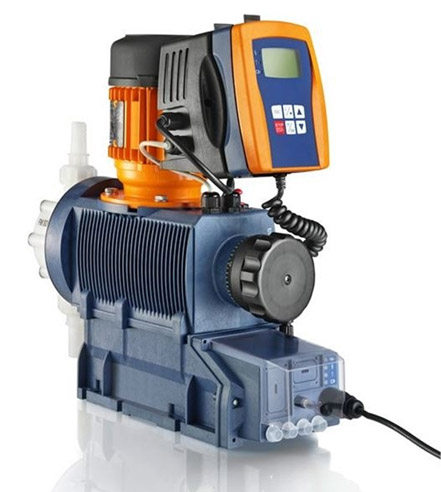
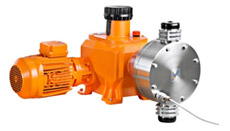
Motor-driven diaphragm metering pumps
Motor-driven diaphragm pumps suit many continuous industrial dosing services. The diaphragm isolates the drive from the chemical, while controlled stroke displacement provides repeatable feed over an appropriate range. They can integrate with flow pacing and plant controls, and configurations are available for different capacities and pressures. Explore the motor-driven metering pump options as a starting point, then verify the specific liquid end, control type, and accessories against the duty.
Plunger metering pumps
Plunger designs are valuable for suitable high-pressure, relatively clean liquid duties. Their packed plunger arrangement requires consideration of controlled leakage, seal or packing adjustment, chemical exposure, and maintenance access. They are not inherently the best answer for crystallising, abrasive, highly hazardous, or gas-releasing chemicals. The plunger metering pump range should be evaluated where pressure and accuracy justify that technology and the fluid is compatible with its sealing concept.
Air-operated double-diaphragm pumps
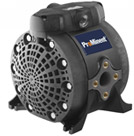
Air-operated double-diaphragm pumps are robust transfer and utility pumps for many treatment-skid tasks, including unloading, sump emptying, and movement of difficult fluids. They are not normally a substitute for a true metering pump when precise, continuously proportional chemical feed is required. Their delivered flow changes with air pressure and discharge resistance unless controlled and verified. The AODP pump page is relevant when the application is transfer or support duty rather than fine metering.
Select wetted materials from complete chemical data
Compatibility depends on chemical identity, concentration, temperature, impurities, and exposure time. “Caustic,” “acid,” or “polymer” is not enough. Obtain a current safety data sheet and process specification. Review the pump head, diaphragm or packing, balls, seats, O-rings, tubing, valves, injection quill, calibration column, tank fittings, and spill-containment components. A system is only as compatible as its least suitable wetted part.
Temperature can change both corrosion rate and mechanical limits. Dilution can be more aggressive to some materials than the neat product, while cleaning chemicals may expose the pump to a completely different fluid. If the line is flushed, specify the flush medium and disposal route. For hazardous or environmentally sensitive chemicals, assess leak detection, bunding, ventilation, emergency isolation, and the consequence of diaphragm or tubing failure as part of the selection.
Specify controls and verification
Decide how the required dose becomes a command. Options include local manual adjustment, pulse input, 4–20 mA pacing, batch control, and digital integration. Define start permissives, low-level shutdown, process-flow interlock, fault output, and behaviour after power restoration. A pump can receive a perfect signal while delivering no chemical because the tank is empty or a valve is blocked, so critical duties may need flow verification or another process confirmation.
Commissioning should include a measured delivery test at representative pressure. A compatible calibration column can show whether actual volume agrees with the intended setting. Record chemical concentration, back pressure, stroke or speed setting, control signal, measured volume, and test duration. This becomes the reference for maintenance and troubleshooting instead of relying on an unverified dial percentage.
Selection pitfalls we see repeatedly
- Quoting only maximum litres per hour and omitting the required minimum.
- Selecting at atmospheric pressure when injection occurs in a pressurised line.
- Using a generic compatibility statement without concentration and temperature.
- Ignoring gas release, viscosity, solids, or suction lift.
- Buying accessories separately without checking their pressure losses and materials.
- Assuming an AODP transfer pump will provide metering-pump accuracy.
- Choosing a control option before defining the plant signal and failure state.
When to call JAMS
Involve JAMS early when the duty is high pressure, the chemical is difficult, the range is wide, an existing pump loses prime, or a dosing point is being connected to PLC control. Send chemical and concentration, flow range, pressure profile, temperature, viscosity if known, tank and injection elevations, pipe details, power, area conditions, control signals, and redundancy requirement. Photographs and a simple process sketch often prevent incorrect assumptions.
We can compare the duty against appropriate pump principles and identify the accessories and unanswered questions needed for a reliable package. We will not claim that one family solves every application. Good selection is a documented fit among capacity, pressure, materials, hydraulics, control, and the people who must operate the equipment.
FAQ
Is a larger metering pump safer for future demand?
Only if the added capacity still leaves normal and minimum duty in a controllable range. Severe oversizing can worsen repeatability and control. Define a credible future case, then check both ends of the operating range or allow a planned pump or solution change later.
Why is actual flow lower than catalogue capacity?
Catalogue ratings use stated reference conditions. Higher pressure, viscous liquid, gas in the head, poor suction, worn valves, incorrect stroke settings, or restrictive accessories can reduce delivery. Measure flow under representative site conditions and diagnose the whole hydraulic path.
Can water be used to calibrate a chemical pump?
Water can support safe initial checks, but it may not represent the density, viscosity, gas behaviour, or valve performance of the process chemical. Final verification should follow an approved method that accounts for the actual fluid and operating pressure.
Which information is essential for material selection?
Provide exact chemical name, commercial formulation, concentration, temperature range, impurities or solids, cleaning fluids, and safety data. Also describe whether vapour, crystallisation, permeation, or long stagnant periods are expected. Every wetted accessory requires the same review.