

A jar test is valuable because it turns a cloudy wastewater sample into visible treatment evidence. It can compare coagulants, establish an approximate dose, show floc formation, and indicate a suitable pH window. It does not, by itself, specify a chemical-feed pump. Between the laboratory beaker and the full-scale clarifier lie changing flow, product strength, solution preparation, pipe losses, mixing energy, process delay, and the practical limits of the selected dosing equipment.
Jams (Pvt.) Ltd works with industrial wastewater duties in textile processing, chemical plants, cement facilities, and shared utilities across Pakistan. Our applications approach is to preserve the basis of the jar test while translating it into an operating range that the plant can measure and maintain. This sits within our broader water treatment and disinfection support, where chemical feed, mixing, instrumentation, and solids separation must function as one treatment train.
What a jar-test result really tells you
A result reported as milligrams per litre should state exactly what was dosed. It might mean milligrams of commercial liquid product, active coagulant, neat polymer, or prepared solution. Those bases are not interchangeable. A result should also record sample temperature, pH, rapid-mix and slow-mix conditions, settling time, product batch, preparation method, and the visual or analytical criterion used to select the dose.
Wastewater is not constant. A composite sample may hide short high-load events from dyeing, washing, cleaning, or production changeover. A grab sample may overstate a temporary upset. The jar-test programme should therefore explore a credible range rather than identify one “perfect” number. Minimum, normal, and maximum doses can then be paired with minimum, normal, and peak plant flow to define the dosing envelope.
- Confirm whether the test dose is expressed as product, active ingredient, or prepared solution.
- Repeat promising conditions on representative samples from different operating periods.
- Record pH adjustment separately from coagulant and flocculant demand.
- Observe floc strength and settling, not only the clarity of the final supernatant.
- Check whether downstream sludge handling can accept the resulting solids volume and character.
Convert the laboratory dose into mass flow
The scale-up begins with wastewater flow. Multiplying cubic metres per hour by the selected dose in milligrams per litre gives grams per hour of product when units are handled consistently. If the jar-test dose is based on active content, divide by the active fraction of the commercial product. If the plant prepares a diluted solution, divide again by the prepared concentration and account for density to obtain the required pump flow in litres per hour.
Every conversion should be written on a calculation sheet with units. This prevents a common thousand-fold error between litres and cubic metres and exposes ambiguity over percentage concentration. For prepared polymer, the make-up recipe, maturation volume, batch interval, and usable ageing period should match the assumptions used to size the feed pump and day tank.
Build a duty range, not a single duty point
Calculate at least four useful cases: minimum flow with minimum dose, normal flow with normal dose, maximum flow with expected high dose, and a defined upset case. The pump should cover the required maximum at pressure while operating predictably at the low end. If the range is too wide, two pump sizes, staged operation, or a change in prepared solution concentration may provide better control than one heavily oversized pump.
Maximum plant flow is not always the decisive condition. A concentrated product at low flow can require an extremely small liquid rate, while a weak prepared solution at peak flow can demand a much larger pump. Solution concentration can be adjusted only within the chemical supplier’s preparation guidance and the limits of mixing, stability, viscosity, and storage. It should never be changed solely to make an available pump appear suitable.
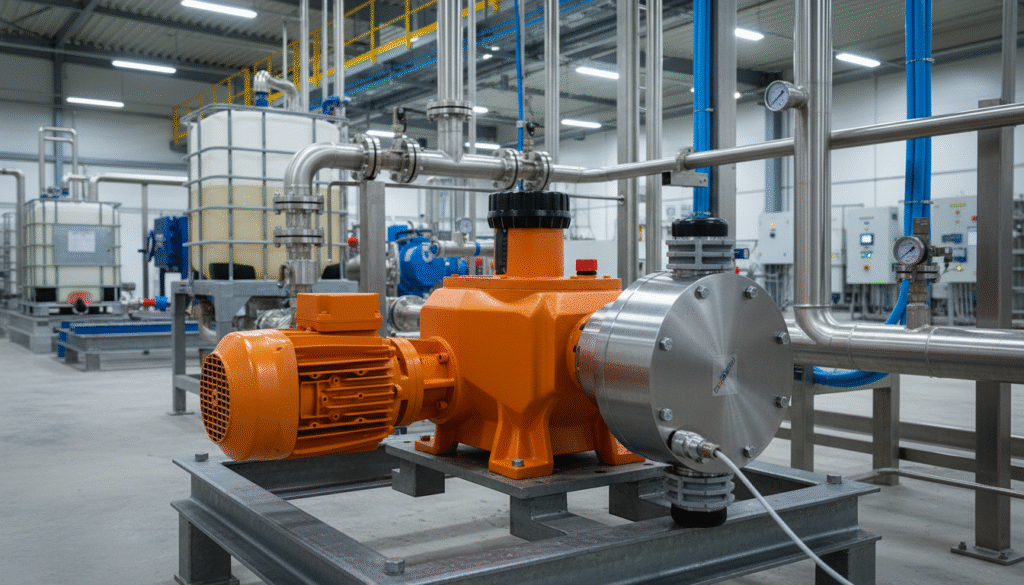
Match pump technology to the prepared chemical
Coagulants such as ferric salts, alum-based products, or pH-adjustment chemicals may behave as relatively free-flowing liquids, although corrosivity and crystallisation still require careful materials and valve selection. Flocculant polymers can be more difficult. Prepared polymer may be viscous, prone to air entrainment, sensitive to shear, and capable of forming deposits when spills dry. The suction line, valve geometry, operating speed, and flushing method can matter as much as nominal capacity.
A plunger metering pump can be considered for suitable clean, low-volume, high-pressure chemical duties where its pressure capability and metering characteristics are useful. It is not an automatic choice for every polymer solution: packing leakage, shear behaviour, solids, and suction conditions must be reviewed. For viscous flocculants, another positive-displacement principle may be more appropriate. Selection follows the fluid and duty, not the desire to standardise one pump type everywhere.
Establish real discharge pressure
The pump must overcome pressure at the injection point, static elevation, pipe friction, injection-valve cracking pressure, and accessory losses. Clarifier inlets are often near atmospheric pressure, which can encourage siphoning if a chemical tank sits higher than the point of injection. A back-pressure or anti-siphon device may be needed for repeatable delivery. Conversely, injection into a pressurised transfer main requires pressure margin and properly rated tubing, valves, and relief protection.
Give the suction side priority
Keep suction piping short and generously sized, especially for prepared polymer. Avoid high lift, unnecessary fittings, and pockets that trap air. A flooded suction can improve reliability when it is chemically and mechanically safe. Tank agitation should prevent separation without damaging the polymer structure. Level switches, a calibrated column, isolation valves, and a controlled drain support operation, but their materials must be checked against each chemical.
Control the dose around process reality
A fixed manual pump setting assumes fixed wastewater flow and demand, an assumption rarely valid for industrial effluent. Flow pacing is a useful foundation: the flow meter supplies the throughput signal and the pump applies a dose ratio. Operators can adjust the ratio using jar tests and process observations. Feedback from pH, turbidity, streaming current, or other suitable measurements can refine control, but only when the measurement is representative and its response time is understood.
Coagulant must reach the correct rapid-mix zone, and flocculant normally follows after the intended reaction period at a location that provides distribution without excessive shear. Moving an injection quill for convenience can invalidate otherwise correct dosing calculations. The time from a pump adjustment to a visible clarifier response should be documented so operators do not repeatedly increase and decrease the dose before the previous change has reached the process.
Pitfalls during scale-up and operation
- Using a jar test from one unusual sample as the permanent plant setpoint.
- Confusing active chemical dose with litres of diluted solution.
- Ignoring density, viscosity, solution ageing, or make-up inconsistency.
- Oversizing the pump until normal duty falls below its useful control range.
- Calibrating with clean water and assuming viscous polymer delivery will be identical.
- Injecting coagulant and polymer too close together or into an unsuitable mixing zone.
A further mistake is judging performance only by supernatant clarity. Excess chemical can produce clear water in a beaker while increasing sludge, cost, residual metal, or downstream load. Pump settings should be linked to verified prepared concentration and measured delivery, not handwritten dial positions with no date or basis.
When to call JAMS
Involve JAMS when moving from pilot work to a permanent installation, when the current pump cannot hold low flow, when polymer repeatedly loses prime, or when injection pressure and piping are uncertain. Send representative jar-test records, wastewater flow data, chemical technical and safety data, solution preparation details, injection-point photographs, elevations, control signals, and the required redundancy. We can identify missing design inputs before a pump and accessories are committed.
Our role is to translate the treatment provider’s chemical programme into reliable equipment duty and controls without inventing a performance guarantee that the available data cannot support. For review of a specific flocculation train in Pakistan, contact JAMS with both the laboratory basis and the site conditions.
FAQ
Can I size the pump from the best jar-test dose only?
No. The best observed dose is one input. Size from a credible dose range, plant flow range, product basis, prepared concentration, density, and pressure. Repeat testing across representative wastewater conditions before defining the maximum and minimum duties.
Why is the full-scale dose sometimes different from the jar test?
Full-scale mixing energy, reaction time, temperature, sample variability, chemical preparation, injection location, and hydraulic short-circuiting differ from a beaker. The jar test establishes a rational starting range; controlled commissioning and monitoring establish the operating setting.
Should coagulant and polymer use the same pump size?
Not necessarily. Their required mass rates, prepared concentrations, viscosity, chemical compatibility, and injection pressures can be very different. Each duty should be calculated and selected independently, even when the pumps are mounted on the same skid.
How should delivered flow be verified?
Use a safe, chemically compatible calibration method such as a calibrated suction column, following the equipment and site procedure. Test at representative discharge conditions and with the actual prepared solution where permitted. Record measured volume, time, pump setting, pressure, and solution concentration.