
Continuous chemical feed is demanding precisely because it looks routine. A pump may run for long periods with no operator beside it, yet small errors accumulate into unstable residuals, excess chemical use, poor product quality, or avoidable maintenance. The duty can change with process flow and pressure, while chemical temperature, concentration, and tank level alter suction behaviour. A robust installation therefore needs more than a pump capable of reaching the maximum litres per hour.
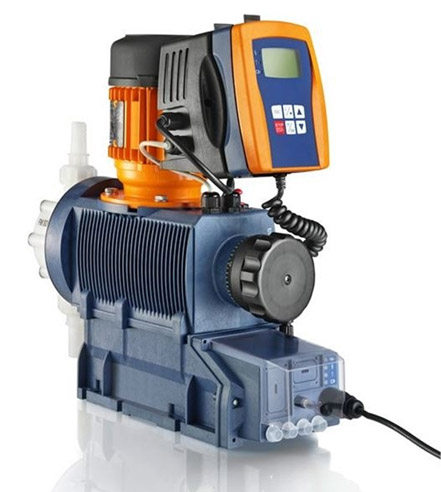
The ProMinent SIGMA X Control Type is a motor-driven metering-pump family intended for industrial dosing applications where capacity, pressure, controllability, and sustained operation must be considered together. Jams (Pvt.) Ltd supports its application in Pakistan for suitable water-treatment and process duties. Our SIGMA X and motor-driven metering information provides the product route; this article focuses on the engineering around a reliable continuous feed point.
Why motor-driven metering suits continuous duty
A motor-driven metering pump converts rotary drive motion into repeated displacement at the liquid end. In a diaphragm configuration, the process chemical is separated from the drive mechanism by the diaphragm. Each correctly completed stroke moves a controlled volume, subject to valve performance, filling, discharge pressure, and fluid behaviour. Capacity can be adjusted within the selected pump’s operating range and controlled in response to plant demand.
This principle is useful for coagulants, inhibitors, disinfectants, pH reagents, and selected process additives when the model and materials match the service. “Continuous” does not mean one permanent manual setting; it means the feed system maintains dependable delivery throughout the operating cycle.
- Normal duty should fall in a stable, useful part of the selected capacity range.
- The liquid end must fill completely under the worst credible suction condition.
- The discharge assembly must maintain controlled pressure and prevent siphoning.
- Wetted materials must suit chemical concentration, temperature, and cleaning fluids.
- Controls and alarms must reflect the process consequence of missed or excess dosing.
Define the SIGMA X duty before choosing a size
Calculate required delivery from process flow, target chemical dose, product strength, and density. Use minimum, normal, and maximum cases. If treatment demand varies independently of flow, include that variation explicitly. State whether the requirement is commercial product, active ingredient, or diluted solution. For intermittent steps, define both total batch quantity and available injection time.
Then establish discharge pressure. Include vessel or line pressure, static elevation, tubing friction, injection-valve opening pressure, and accessories. Review transients and the blocked-line case separately from normal operation. The pump and every connected component need appropriate pressure ratings, while a relief route must discharge somewhere chemically safe. Atmospheric catalogue capacity alone cannot establish performance in the installed system.
Avoid false safety through oversizing
Adding unexplained capacity margin can place routine demand too close to the low end of adjustment. This is particularly troublesome when one pump is expected to cover low night flow and a much higher daytime maximum. A reasoned margin is necessary, but it should be tied to measured uncertainty or a defined future condition. Very wide ranges may be better served by staged pumps or a reviewed change in solution concentration.
Build dependable suction and discharge hydraulics
The suction side should be short, correctly sized, and free from air pockets. A flooded arrangement is generally favourable when the chemical, tank, and containment design allow it. Check maximum and minimum tank levels because suction pressure changes over the batch. Gas-releasing chemicals, viscous liquids, low temperature, clogged foot valves, or a narrow line can prevent complete filling and reduce delivered flow even though the drive operates normally.
On discharge, back pressure helps check valves work consistently. A back-pressure valve may be needed when the process pressure is low or variable. An anti-siphon function is essential where elevation can pull chemical through a stopped pump. Longer lines may require pulsation analysis and a dampener. Accessory set pressures must be coordinated; an arbitrary combination can consume pressure margin or prevent the intended protection from operating.

Use the Control Type as part of a control philosophy
A controllable pump is not automatically a controlled process. Decide whether the base command will be local, pulse-paced, analogue, batch, flow proportional, or generated through an integrated plant strategy supported by the chosen configuration. Document signal scaling and behaviour at zero demand, signal loss, process shutdown, low tank level, and pump fault. The operator should be able to distinguish “commanded to run” from “chemical delivery confirmed.”
For many utility applications, flow pacing is a sound foundation. A water or process-flow signal determines the base chemical rate. An analytical variable such as pH, ORP, residual, or conductivity may provide bounded trim where the chemistry and sample delay support it. The loop should include a maximum output and appropriate permissives so that a failed or fouled sensor cannot demand unlimited feed.
Coordinate with the PLC without losing local clarity
Remote integration should transmit only signals that have defined meaning. Typical needs include run enable, demand, ready status, common fault, and low chemical level; the final list depends on the selected equipment and plant architecture. Local indication remains important for maintenance and commissioning. Clearly label whether adjustment authority sits at the pump, local panel, or PLC to prevent two control sources from fighting each other.
Materials and chemical handling remain decisive
SIGMA X is a family, not one universal liquid end. The exact chemical name, formulation, concentration, temperature, contaminants, viscosity, and gas behaviour are needed to review head, diaphragm, valves, seals, tubing, and accessories. Stronger is not always better: a premium metal can be unsuitable for a chemical that works well with an appropriate polymer. Compatibility must include startup and flushing fluids as well as normal product.
Tank design affects pump reliability. Provide a suitable vent, level monitoring, bunding, safe filling, and a means to isolate and service the suction line. Agitation should maintain a uniform solution without introducing damaging shear or excess air. For chemicals that degrade, the day-tank volume and make-up frequency should avoid extended ageing. These are process decisions, not optional extras attached after pump selection.
Commission the feed as a measured system
Before introducing chemical, verify mounting, oil or drive checks required by the product instructions, valve orientation, electrical supply, interlocks, relief destination, and pipe support. Prime using the approved chemical procedure and personal-protection requirements. Never open a pressurised chemical connection to “see whether it is pumping.” Confirm leak tightness and safe drainage under controlled conditions.
Measure delivered volume at representative pressure using a compatible calibration method. Test at more than one operating point when the process depends on turndown. Record the setting or command, back pressure, measured volume, time, chemical concentration, and tank condition. Confirm that analogue or pulse scaling matches the PLC. Finally, test low level, loss of process flow, signal failure, and pump alarm responses rather than assuming the wiring drawing proves them.
Pitfalls that undermine continuous feed
- Selecting from maximum capacity without checking minimum stable demand.
- Routing a long or narrow suction line because it is convenient for the tank layout.
- Ignoring gas release from the chemical and repeatedly treating loss of prime as a valve fault.
- Operating into little pressure without anti-siphon or back-pressure control.
- Scaling a 4–20 mA signal differently at the PLC and pump.
- Assuming a running indication proves actual chemical movement.
- Skipping calibration after replacing valves, diaphragm components, or solution strength.
When to call JAMS
Bring JAMS into the project when replacing an unreliable continuous-feed pump, moving from manual to flow-paced control, adding standby equipment, or preparing a new dosing skid. Provide chemical data, required range, pressure profile, suction layout, temperature, power, area conditions, control signals, redundancy, and site photographs. We can identify the appropriate SIGMA X configuration where the family fits and define the associated hydraulic and control requirements.
JAMS is an authorized ProMinent partner in Pakistan. Our ProMinent authorization section describes that relationship. Authorized supply supports a clear product and technical-information path, but successful service still depends on correct site data, installation, commissioning, and maintenance.
FAQ
Is SIGMA X suitable for every continuous dosing application?
No pump family is universal. Suitability depends on required flow and pressure, chemical compatibility, suction conditions, control needs, environment, and maintenance strategy. The exact model and liquid end must be selected from complete duty data.
Should capacity be adjusted by stroke or by the control signal?
The correct method depends on the selected configuration and required operating range. Establish a mechanically and hydraulically sound base setting, then use the supported control input as intended. Commissioning should verify actual delivery across the commanded range.
Does the pump need a pulsation dampener?
Not automatically. Need depends on displacement per stroke, line length and elasticity, pressure, instrumentation sensitivity, and process tolerance. A hydraulic review should also coordinate dampener pre-charge and location with back-pressure and relief devices.
How is standby operation handled?
Duty/standby pumps need independent isolation, compatible common piping, non-return protection, clear changeover logic, and periodic proving. Automatic transfer should respond to meaningful failure evidence, while alarms tell operators which pump is active and why transfer occurred.