
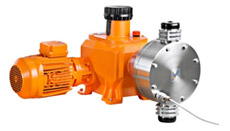
High-pressure chemical injection is not solved by selecting a pump with a maximum pressure above the line rating. Accurate metering depends on how completely the pumping chamber fills, how consistently the check valves seat, how packing leakage is managed, and how the discharge system responds to each stroke. A plunger pump can provide controlled positive displacement at demanding pressure, but its accuracy must be engineered and verified at the installed duty.
At Jams (Pvt.) Ltd, we consider plunger metering for suitable applications in process plants, chemical facilities, cement utilities, and water-treatment systems across Pakistan. The technology is especially relevant when a clean liquid must be injected at a pressure or duty point suited to a packed plunger arrangement. Our plunger metering pump information introduces the product category; selection begins with the process details below.
How plunger metering produces controlled flow
A reciprocating plunger changes the volume of the liquid chamber. On the suction stroke, the inlet check valve opens and liquid fills the chamber. On the discharge stroke, the inlet closes, the outlet opens, and a defined displacement moves into the line. Adjustment of effective stroke or operating rate changes average delivery. Instantaneous flow remains pulsating even when the hourly average is stable.
The plunger passes through packing that limits leakage while allowing movement. This differs from a diaphragm liquid end, where a diaphragm isolates the process fluid from the drive. Packing condition, adjustment, lubrication where applicable, chemical compatibility, and leakage handling are therefore central to plunger-pump operation. Zero visible leakage should not be promised without reference to the exact design and manufacturer instructions.
- Pressure capability must exceed the calculated operating duty with appropriate design review.
- Plunger, packing, valves, seats, and all accessories must be chemically compatible.
- Suction pressure must allow complete chamber filling at the selected stroke rate.
- Discharge pulsation and acceleration effects must be acceptable to the line and process.
- Leakage collection, inspection, and maintenance access must be planned before installation.
Accuracy, repeatability, and turndown are different
Accuracy describes closeness to a defined true value under stated conditions. Repeatability describes how closely repeated results agree under the same conditions. Linearity describes how delivery follows adjustment across a range. A pump may repeat a biased flow very consistently if it was never calibrated at site pressure. Procurement specifications should state which performance matters, over what operating range, and under which fluid and pressure conditions.
Turndown is likewise not just the ratio between nameplate maximum and a nominal minimum setting. At low displacement, valve leakage, trapped gas, packing condition, and each individual stroke become more significant relative to delivered volume. If normal duty is only a tiny fraction of maximum capacity, a smaller liquid end or different arrangement may give better usable control. Oversizing cannot be corrected simply by turning the setting down.
Establish the complete high-pressure duty
Start with normal, minimum, and maximum process pressure. Include static head, friction, injection-valve cracking pressure, and pressure variation during different plant states. Check the maximum credible blocked-line pressure separately. A positive-displacement pump can continue building pressure against a closed discharge, so properly selected relief protection is essential. The relief destination must safely contain the chemical and must not create a new closed volume.
Calculate required chemical flow from active dose, product concentration, density, and process throughput. For batch injection, divide the total volume by the available feed time and check whether the receiving process can accept the pulsed input. For continuous proportional dosing, define the full demand range and control signal. Capacity at atmospheric discharge is not a valid substitute for performance at the required high pressure.
Consider pressure variation, not only maximum pressure
A pump may meet capacity at maximum pressure yet deliver a different amount when header pressure falls. Check valves, packing leakage, and hydraulic accessories contribute to the relationship. A back-pressure device can provide a more consistent differential where process pressure varies, but its set pressure adds to pump duty. Selection should use the combined pressure rather than treating the accessory as hydraulically free.
Protect suction performance
High discharge pressure does not imply strong suction capability. During the suction stroke, the chamber must fill quickly enough to avoid cavitation or incomplete filling. Long small-bore suction lines, excessive lift, cold viscous chemical, clogged strainers, vapour release, and high stroke speed all reduce filling. A short flooded suction is often preferred when chemical safety and tank arrangement permit it.
Acceleration pressure in reciprocating service can be important, particularly with long lines. The liquid column must repeatedly start and stop, creating pressure fluctuations beyond simple steady friction loss. A suction stabiliser may be needed after calculation, but it should not be added by habit. Tank nozzle size, line stiffness, liquid density, viscosity, vapour pressure, and stroke characteristics all affect the review.
Select materials and packing deliberately
Provide exact chemical formulation, concentration, temperature, solids, contaminants, and cleaning media. Review compatibility for plunger, packing, valves, seats, body, gaskets, tubing, relief valve, dampener, and injection assembly. Abrasive solids can damage sealing surfaces. Crystallising chemicals can prevent valves from seating. Gas release can disrupt volumetric performance. A high pressure rating does not remove these fluid behaviours.
Packing selection balances chemical resistance, friction, sealing, temperature, and maintenance. Over-tightening can increase heat and wear; insufficient adjustment can increase leakage. Follow the manufacturer procedure and provide safe access for inspection. Leakage should be collected in a manner compatible with the chemical.
Manage discharge pulsation
Each discharge stroke creates a pressure and flow pulse. In a short robust line this may be acceptable; in a long line it can cause vibration, gauge movement, noise, fatigue, or unstable downstream measurement. A properly sized pulsation dampener can absorb part of the variation, provided its pressure rating, bladder material, pre-charge, and location suit the service.
Pipe supports and small-bore connections deserve attention. A pressure gauge on an unsupported nipple can fail under repeated motion. Injection quills, valves, and instrument lines should be arranged for the dynamic duty. Do not use flexible hose as an uncalculated dampener; its movement, rating, compatibility, and restraint still require engineering.
Verify metering performance on site
Commissioning should first confirm alignment, mounting, lubrication requirements, valve direction, motor rotation where relevant, relief route, guards, and electrical interlocks. Prime and vent only through the approved safe procedure. Raise pressure in a controlled manner while checking for leakage and abnormal noise. Never tighten a pressurised packing or connection unless the product procedure explicitly provides a safe method.
Measure delivered volume at representative pressure and several required settings. Use a compatible calibration arrangement, and allow the system to stabilise. Record fluid, temperature, pressure, setting, stroke rate where available, test time, measured volume, and observed packing leakage. Repeatability can be assessed by repeated runs; accuracy requires a trustworthy reference measurement. Recheck after valve or packing maintenance and after a significant chemical change.
Common high-pressure metering pitfalls
- Selecting only by pressure and overlooking the minimum controllable capacity.
- Assuming the pump can lift any chemical because it can discharge at high pressure.
- Ignoring packing leakage and providing no safe collection route.
- Using steady-state friction alone for a long reciprocating suction or discharge line.
- Installing a relief valve with an isolated, undersized, or unsafe return path.
- Claiming accuracy from a dial setting without site calibration.
- Leaving pulsating small-bore fittings unsupported.
When to call JAMS
Contact JAMS when injection pressure exceeds the comfortable range of an existing system, a packed plunger is being considered for a new chemical, actual delivery changes with header pressure, or pulsation is damaging instruments and piping. Share chemical data, flow range, pressure profile, suction layout, temperatures, pipe lengths and sizes, control method, power, area conditions, and required redundancy.
We can review whether plunger technology is appropriate, define unanswered hydraulic and materials questions, and support selection and commissioning for the documented duty. Accuracy is not inferred from technology name alone. The result comes from correct sizing, stable hydraulics, suitable packing and valves, measured calibration, and disciplined maintenance.
FAQ
Are plunger metering pumps always more accurate than diaphragm pumps?
No. Accuracy depends on the specific design, operating range, fluid, pressure, calibration, and condition. Plunger technology is valuable for suitable high-pressure duties, but a correctly selected diaphragm pump may be better for chemicals requiring process containment or different suction behaviour.
Why does flow decrease at higher discharge pressure?
Higher pressure can increase leakage through clearances or packing and alter valve behaviour, while inadequate suction filling may become more visible at operating speed. Compare measured performance with the selected pump data and inspect both suction and discharge conditions.
Is some packing leakage normal?
That depends on the exact pump and packing design. Controlled leakage may be part of how certain packed plungers operate and cool or lubricate the sealing interface. Follow manufacturer limits and provide safe collection; do not impose a generic rule.
When is a pulsation dampener required?
Use one when hydraulic analysis or observed system behaviour shows unacceptable pressure variation, vibration, or process disturbance. It must be sized and pre-charged for the operating pressure and pulse volume, with compatible materials and a suitable installation location.