
Working with a global manufacturer is most effective when the local support path is clear. For ProMinent equipment in Pakistan, Jams (Pvt.) Ltd helps connect plant requirements with product selection, supply coordination and agreed field support. That path is not a single sales conversation. It begins with defining the chemical and hydraulic duty, continues through installation and commissioning, and becomes a lifecycle relationship once the equipment enters routine operation.
The starting point is to confirm the current principal relationship through the ProMinent authorization information. From there, the following stages show how an enquiry can move from an operational problem to a maintainable dosing solution.
Stage 1: describe the duty, not only the pump
A useful enquiry explains what the plant is trying to dose and why. The chemical name and concentration are essential, but they are not enough. JAMS will normally need the required average and maximum feed rate, discharge pressure, suction arrangement, fluid temperature, likely viscosity, solids or gas-release behaviour, daily operating pattern and the control signal available. The receiving process also matters: dosing into an open tank is different from injecting into a pressurized line.
For replacement work, the existing nameplate and model code help identify what is installed. We still ask whether the old duty remains valid. Plants change production rates, chemical strength, pipe routes and control philosophy over time. Repeating an old order code without checking these conditions can preserve an old sizing error.
Stage 2: select the whole metering arrangement
Pump capacity receives most of the attention, yet stable dosing depends on the entire hydraulic arrangement. Selection should consider wetted materials, available suction head, suction-line length, injection pressure, pressure variation and the required turndown. Accessories may include a foot valve, injection valve, relief protection, back-pressure device, pulsation control, calibration column or leak monitoring, depending on the application. They are not automatic additions; each should solve a defined hydraulic, safety or maintenance need.
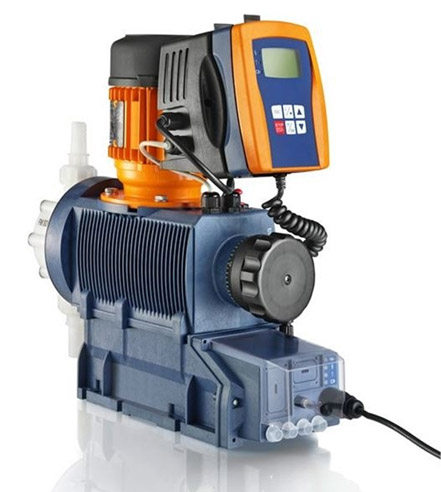
For continuous and demanding duties, the motor-driven metering pump range is one possible starting point. The final choice must follow actual process data and manufacturer guidance rather than a family name alone.
Stage 3: close technical questions before the purchase order
Once a provisional configuration is identified, the plant and JAMS should close the remaining assumptions in writing. These may include the stated capacity at a defined back pressure, motor and electrical details, enclosure, control input, alarm outputs, liquid-end materials, process connections and included accessories. If a certificate, drawing or particular document is required, it should appear in the commercial scope instead of being requested after dispatch.
This stage is also the right time to agree who will fabricate the skid, install cabling, provide isolation and flushing, arrange chemical availability and perform site safety reviews. Clear interfaces prevent the common commissioning-day discovery that the pump is present but the system is not ready.
Stage 4: prepare the site for startup
Commissioning works best when it is treated as verification, not construction completion. Before a visit, the installation team should check that the pump is securely mounted, piping is clean and correctly supported, suction and discharge valves are oriented, relief discharge has a safe destination, electrical protection matches the design and control signals can be simulated. Chemical handling arrangements, personal protective equipment and emergency measures remain the plant’s responsibility.
Where water can safely be used for initial checks, it may allow leaks, valve operation and basic capacity to be assessed without introducing process chemical. This is application-dependent: water is not compatible with every chemical system, and residual water can be hazardous for some media. The agreed startup method should therefore follow the safety data and site procedure.
Stage 5: commission against defined acceptance points
At startup, the objective is to show that the supplied package is installed correctly and responds as intended within the available conditions. Typical checks include rotation where relevant, priming, leak inspection, relief path, local controls, stroke or speed adjustment, external command response, alarm contacts and a measured delivery check. A calibration column or timed drawdown can help compare actual feed with the required duty, provided the test setup and liquid properties are suitable.
The measured rate should be recorded with the operating pressure, settings and test medium. A single number without those conditions is difficult to reproduce. If the result differs from expectation, the team should examine suction conditions, trapped gas, valve cleanliness, pressure and test method before concluding that the pump is defective.
Stage 6: hand knowledge to operators and maintenance
A practical handover focuses on what each role needs. Operators should understand normal indications, permitted adjustments, alarm response and when to isolate the package. Maintenance personnel need inspection points, safe depressurization, consumables, correct spare identification and the consequences of changing valve or diaphragm components. Instrument and automation teams need signal scaling, permissives and fail-state logic.
JAMS can support this handover within the agreed scope, but site-specific operating procedures must be owned and approved by the plant. Training should use the installed configuration and actual interlocks, not only a generic product presentation.
Stage 7: build an after-sales record
After commissioning, retain the final model code, serial number, settings, commissioning sheet, manuals, drawings and spare-parts list in the plant’s maintenance system. When requesting support, include this record together with a concise description of the symptom and recent process changes. “Pump not working” starts a long diagnostic exchange; “unit runs locally, loses external pulse command after panel work, no active pump alarm” gives the support team a direction.
Recommended spares should reflect duty and consequence. A continuously operating critical pump may justify a different strategy from an intermittent utility pump with installed standby capacity. JAMS can help identify compatible parts and coordinate principal input, while the plant determines how much risk to hold locally.
A support path with shared responsibilities
The ProMinent–JAMS path brings manufacturer product knowledge closer to Pakistani sites, but it works only with accurate information and disciplined installation. JAMS does not replace the process designer, safety authority, electrical contractor or plant maintenance team. We help these parties make a better-connected decision and establish a route for follow-up. Learn more about the company on our about page.
Frequently asked questions
Can JAMS select a ProMinent pump from flow rate alone?
No. Flow rate is only one selection input. Pressure, chemical and concentration, temperature, material compatibility, suction conditions, control method, operating pattern and area requirements can change the correct configuration. Providing a complete duty early is the fastest route to a useful proposal.
Is commissioning included with every equipment purchase?
Not automatically. Site attendance, duration, travel, prerequisites and acceptance activities should be stated in the quotation or order. Some supplies may include remote guidance, while a project package may include a defined site scope. Confirm this before placing the order.
Will a metering pump deliver its nameplate maximum in every installation?
No. Published capacity applies under stated conditions, and actual delivery is affected by pressure, liquid properties, suction design, valve condition and settings. The selected pump should be checked against the real duty, then verified using a suitable site test method.
How should we request help for an installed ProMinent unit?
Share the full model and serial details, photographs of the unit and piping, current settings, chemical, suction and discharge conditions, alarm text, control mode and a timeline of the fault. Include any recent maintenance or process change. Structured evidence allows JAMS to respond or escalate more effectively.