
Compressed-air measurement becomes valuable when it answers an operating question: where is air being consumed, when does demand peak, is the dryer maintaining the required dew point, and which leaks deserve repair first? CS Instruments offers technologies that address different parts of that picture. Jams (Pvt.) Ltd supports the portfolio in Pakistan by helping plants connect the measurement objective to a suitable instrument, installation plan and usable handover.
Our relationship with the principal can be checked on the CS Instruments authorization section. Authorization provides the route; a successful project still depends on correct application data, installation quality and clear ownership of the resulting information.
Start with the decision the data must support
A request for “a compressed-air meter” can lead to very different systems. A utility manager may need total generation from the compressor house. Production may want consumption by department or machine. Maintenance may need a temporary survey to compare loaded and idle demand. Finance may require a repeatable basis for allocating utility cost. Each objective affects the location, range, logging interval, communication method and permanence of the installation.
JAMS begins by asking what action should follow the reading. If no one knows who will review the data or what threshold will trigger work, adding a sensor may only create another number on a screen.
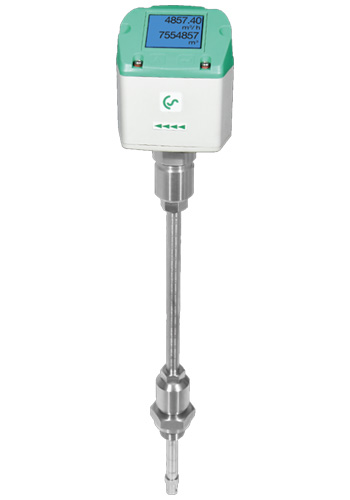
VA 500 for compressed-air and gas flow visibility
The VA 500 flow meter is relevant where thermal mass measurement suits the medium and operating conditions. In compressed-air applications, an insertion-style sensor can support main or branch monitoring when pipe dimensions, insertion position, available straight run and installation access are properly considered. The exact sensor and configuration must be selected for the stated gas, pressure, temperature, range and pipe.
Thermal mass technology can provide a direct basis for standardized flow without relying on a separate pressure and temperature compensation arrangement in the same way as some volumetric methods. However, “standard” or “normal” volume is not universal. Base temperature, pressure and units must be aligned across the instrument, logger, plant historian and reports. Otherwise two correct-looking displays can disagree because they use different reference conditions.
LeakCam 600 for locating multiple leak sources
Flow measurement shows that waste exists but does not reveal every source. The LeakCam 600 supports acoustic imaging of compressed-air and gas leaks, which can be useful in noisy industrial settings and where several potential sources are visible in one area. A survey should still follow a controlled route, identify assets clearly and record enough context for maintenance to find the same point later.
A camera does not repair a leak, and an estimated loss is not the same as a verified saving. The maintenance workflow should move from detection to tagging, prioritization, safe repair and reinspection. Main flow trends can then help determine whether off-production demand has changed after a repair campaign.
Dew point, pressure and data logging complete the picture
Air quality and energy performance are connected. Excessively conservative dryer operation may consume unnecessary energy, while inadequate drying can threaten valves, instruments or the process. Dew-point measurement should be located and sampled so that it represents the condition of interest, with attention to pressure, sample flow, temperature and contamination. A sensor installed in a poor sampling arrangement can respond slowly or report a misleading value.
Pressure trends help explain flow. A high demand event with stable header pressure has a different operational meaning from the same flow event accompanied by a pressure collapse. Multi-channel displays and data loggers can bring flow, dew point and pressure into a common timeline, provided clocks, units and channel names are configured consistently.
What local commissioning should establish
Commissioning is not simply powering an instrument and observing a number. Within an agreed scope, a structured JAMS visit may address:
- Identity: confirm the model, sensor, accessories and intended measurement point against the order.
- Mechanical installation: review orientation, insertion depth, process connection, safe retraction provisions where applicable, sealing and available straight run.
- Electrical installation: verify supply, earthing, cable routing and output connections against the relevant documentation.
- Configuration: enter pipe dimensions, medium, engineering units, reference conditions, output scaling, addresses and logging intervals.
- Reasonableness: compare readings with the known plant state and investigate obvious contradictions rather than accepting any non-zero display.
- Handover: record settings, explain routine checks and identify who owns data review and maintenance.
The plant and its contractors remain responsible for process isolation, pressure safety, access, electrical compliance and final acceptance. If the pipe is live, any hot-tap or pressurized insertion arrangement requires a method appropriate to the site and equipment. Those controls cannot be improvised during instrument startup.
Protect data quality after the first day
Measurement quality can drift because of contamination, accidental setting changes, altered pipework or a sensor moved during maintenance. A simple governance routine should preserve a configuration backup, inspect the installation periodically, review implausible flat lines or spikes, and record calibration or service events. For temporary campaigns, photograph each point and note the exact installation geometry so repeat surveys are comparable.
Data also needs context. Production status, compressor operating state, shutdowns and seasonal conditions can explain large changes. A weekly report that compares flow without this context may reward or blame the wrong activity. Good measurement programs combine instrument data with operating records rather than treating sensors as independent judges.
Plan a portfolio, not a collection of devices
A practical compressed-air programme often starts with one verified baseline point, then adds branch monitoring, leak surveys and air-quality measurements where they support decisions. Communication architecture should be considered early: local display may be enough for a temporary diagnostic point, while permanent energy accounting may need logging, network integration and controlled data retention.
JAMS can help review the measurement objective, available site conditions and CS Instruments options, then define supply and commissioning boundaries. We do not promise a saving simply because a meter or camera is installed. The outcome depends on how consistently the plant acts on the evidence.
Frequently asked questions
Can one VA 500 measure the consumption of an entire factory?
It can measure the flow at its installed point when correctly selected and installed, but one point cannot explain every department or end use. A main meter provides a useful total. Additional branch or temporary measurements may be required to locate demand and assign responsibility.
Does LeakCam 600 work without stopping production?
Leak surveys are often performed while systems are pressurized because active leaks need to emit sound, but site access and safety rules always apply. Some areas may be inaccessible during operation, and background sources can require careful interpretation. Survey planning should be agreed with plant safety and operations teams.
Is local commissioning the same as calibration?
No. Commissioning checks installation, configuration, signals and reasonable operation at site. Calibration is a defined metrological comparison under specified conditions and should be supported by the appropriate documentation. The required calibration scope must be stated when ordering or arranging service.
What should we provide for a CS Instruments enquiry?
Explain the measurement objective, medium, pipe material and dimensions, pressure and temperature range, expected minimum and maximum flow, installation access, available straight run, power, required outputs and logging needs. For dew point or leak work, include the sample conditions or survey area and the action expected from the result.