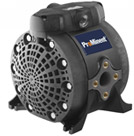
Air-operated double-diaphragm pumps earn their place around treatment skids because they can handle many transfer jobs with a simple pneumatic drive and no conventional electric motor at the pump. They are used for unloading compatible chemicals, moving solutions between tanks, emptying sumps, feeding preparation vessels, and handling fluids that would challenge a small centrifugal pump. Their flexibility does not make them precision metering pumps, and treating them as one is a frequent design mistake.
At Jams (Pvt.) Ltd, we review AODP applications as part of the fluid path around water-treatment and process packages in Pakistan. The correct pump depends on chemical compatibility, solids, viscosity, suction conditions, discharge pressure, required transfer time, and available compressed air. Our air-operated diaphragm pump page introduces the category; a complete skid review determines where it fits and what safeguards are required.
How an AODP pump works
An air distribution mechanism alternately pressurises chambers behind two mechanically linked diaphragms. As one diaphragm pushes liquid out through a discharge check valve, the other draws liquid in through a suction check valve. At the end of the stroke, the air valve shifts and the motion reverses. Ball or flap checks direct liquid flow, depending on the pump design and fluid.
Because the drive uses compressed air, delivered flow responds to air pressure and volume as well as liquid-side resistance. As discharge pressure approaches the available air-driving pressure, the pump slows and can stall without the same blocked-discharge behaviour as many motor-driven positive-displacement pumps. That ability is useful, but it is not permission to omit line ratings, pressure regulation, isolation, or a process review.
- Flow varies with air supply, discharge head, viscosity, suction lift, and check-valve performance.
- Maximum particle size and solids behaviour depend on the selected valve and passage geometry.
- Diaphragm, ball, seat, body, and manifold materials all contact the process fluid.
- Exhaust air can be noisy, cold, and contaminated if a diaphragm fails.
- Pulsating flow affects hoses, instruments, filters, and downstream filling accuracy.
Where AODP pumps fit around a treatment skid
Chemical transfer and unloading
An AODP can transfer chemical from a delivery container to a bulk or day tank when the exact fluid, connection method, and materials are suitable. The pump should not be moved casually among incompatible chemicals. Dedicated connections, labelling, flushing rules, spill containment, and overfill protection are needed. Transfer rate should match tank venting and operator response time rather than simply using the largest available pump.
Solution preparation
AODP pumps can move dilution water or prepared solution into another vessel, and they can circulate certain mixtures where shear and aeration are acceptable. For polymer preparation, however, high recirculation or restrictive throttling can damage product performance or introduce air. The chemical supplier’s mixing and maturation requirements must guide the arrangement. A robust pump cannot correct an unsuitable preparation process.
Sump and sludge-related duties
Some AODP configurations tolerate suspended solids and variable liquid levels, making them useful for selected sump, filter-drain, or sludge-transfer tasks. Particle size, settling, fibrous material, abrasion, and dry deposits can still block checks or wear diaphragms and seats. Sludge duty should be described with solids concentration and character rather than the vague statement “dirty water.”
Metering support, not precision substitution
An AODP may keep a day tank supplied or transfer bulk chemical to a dosing package, while a dedicated metering pump provides the precise process feed. This separation uses each technology for its strength. Trying to obtain stable proportional dosing by throttling an AODP is unreliable because air pressure, discharge resistance, and cycle rate change. Batch volume can be controlled with a measured receiver, flow total, or level change where the required accuracy and controls are properly engineered.
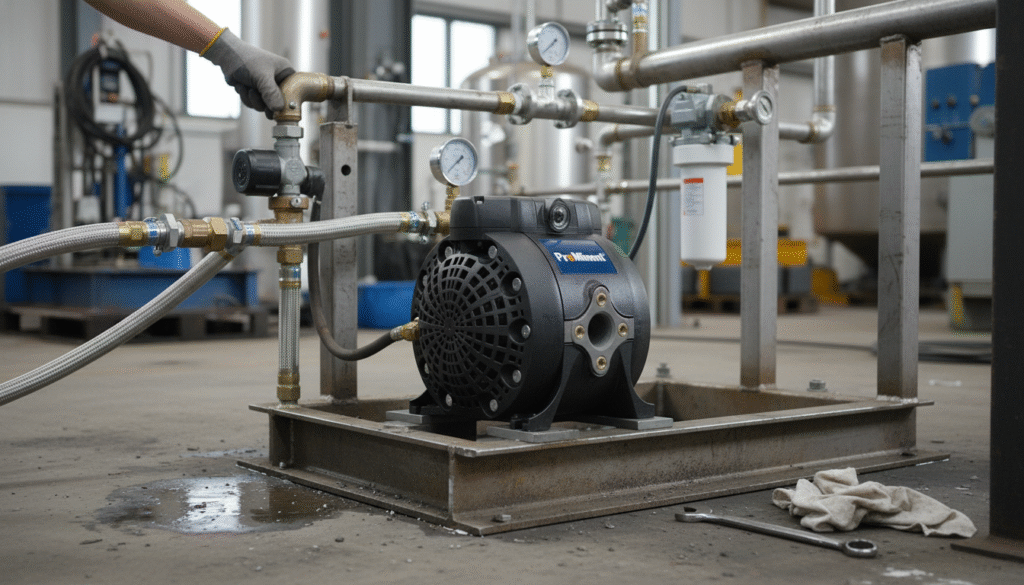
Size from transfer time and system resistance
Define the volume to be moved and the permitted transfer time to establish average flow. Then calculate static elevation, line friction, filter or valve loss, and receiving-vessel pressure. Use the actual liquid viscosity and solids condition. Published free-flow capacity at generous air supply is not the installed duty. The operating point should be checked against manufacturer performance information for the selected size and configuration.
Suction deserves particular attention. Although AODP pumps are often described as self-priming, practical lift depends on pump condition, fluid density and vapour pressure, line tightness, cycle speed, and whether the suction is dry or wetted. A flooded suction is normally more forgiving. Long suction hose, undersized fittings, collapsed liners, clogged strainers, and leaking couplings can cause slow transfer and erratic cycling.
Check the compressed-air source
The plant must provide enough air flow at the pressure needed at the pump while other consumers operate. A small branch line, fouled filter, long hose, or undersized regulator can starve the air valve. Use clean air of the quality required by the selected pump, with regulation and isolation located for safe operation. Lubrication should follow the manufacturer’s guidance; adding oil to a design intended for unlubricated service can create maintenance issues.
Select wetted and air-side materials
Review exact chemical, concentration, temperature, contaminants, solids, and cleaning medium. Body material alone is not enough: diaphragms, backup diaphragms where used, balls, seats, O-rings, manifold seals, and hose must all be compatible. Mechanical life and chemical resistance can point to different elastomers, so selection is an application balance rather than a generic “chemical resistant” label.
A diaphragm failure can allow process fluid into the air section and exhaust. Consider where exhaust is routed, whether leakage detection is needed, and what exposure could occur. In corrosive or indoor areas, remote exhaust may be appropriate when allowed by the product instructions and pressure-loss limits. The installation should make routine inspection possible without placing personnel over an open chemical tank.
Plan controls, hoses, and skid interfaces
A manual air valve may be enough for an attended transfer, but automated duty needs defined start permissives and stop conditions. High receiving-tank level, low source level, closed valve status, leak detection, or a batch total may be relevant. An air solenoid can stop the pump command, yet trapped liquid pressure and gravity flow still need consideration. Lockout must isolate both air and liquid energy.
Use properly rated, chemically compatible, restrained connections. Pulsation can move unsupported hose and fatigue rigid small-bore fittings. A liquid pulsation dampener may smooth discharge for filters or instruments, but it requires correct sizing and maintenance. If flow is throttled, do so within the pump guidance and consider the energy cost: compressed air is an expensive utility, and an oversized pump run inefficiently can waste substantial air.
Common skid-integration pitfalls
- Choosing from free-flow capacity without checking discharge head and air consumption.
- Assuming “self-priming” permits an unlimited, narrow, or leaking suction line.
- Using one portable pump for incompatible chemicals without a validated cleaning procedure.
- Ignoring process-fluid release through the exhaust after diaphragm failure.
- Throttling an AODP and calling the result accurate metering.
- Allowing unrestrained hose to move with every discharge pulse.
- Providing no overfill stop for an attended or automated tank transfer.
When to call JAMS
Contact JAMS when adding transfer duty to a new treatment skid, replacing a troublesome centrifugal or electric pump, handling a fluid with solids, or automating a tank-filling step. Send chemical and safety data, required volume and transfer time, source and destination levels, pipe sizes and length, temperature, solids and viscosity information, available air pressure and capacity, control requirements, and installation photographs.
We can review whether an AODP is appropriate, select materials and size against the real system curve using available manufacturer data, and define air preparation, controls, and installation checks. We will also say when a metering pump or another transfer principle better matches the duty. Good skid design uses AODP flexibility without asking the pump to provide performance its operating principle does not guarantee.
FAQ
Can an AODP pump run dry?
Many designs tolerate dry operation better than liquid-lubricated pump types, but continuous dry cycling can waste air and accelerate wear. Suitability depends on the selected model and fluid. A low-level or no-flow stop is still good practice where dry running is unnecessary.
Can an AODP deadhead safely?
The pump generally stalls when liquid discharge pressure balances the effective air drive, but all components remain pressurised. Confirm manufacturer limits, regulator setting, line ratings, temperature effects, and isolation procedure. “Stalled” does not mean depressurised or safe to open.
Is an AODP suitable for polymer solution?
It may be, depending on viscosity, shear sensitivity, air entrainment, concentration, valve design, and required flow. Review the polymer supplier’s handling guidance and operate at a suitable cycle rate. Do not assume every diaphragm pump treats polymer gently.
Why is the pump cycling but transfer is slow?
Possible causes include insufficient air volume, restricted suction, worn or contaminated checks, excessive lift, high viscosity, a leak on the suction side, blocked discharge, or diaphragm damage. Compare air and liquid conditions with the performance basis before changing pump size.