Machine-level compressed-air metering is often treated as a smaller version of main-header metering. In practice it is a different application. The pipe is smaller, space is tighter, flow cycles faster, and there may be dozens of points to network. An inline meter with its own measuring section can reduce installation uncertainty, but the model still has to match pressure, gas, pipe connection, communications, and the reason for measuring.
CS Instruments positions both VA 520 and VA 525 as thermal, inline consumption meters. They share the calorimetric principle and can provide flow and accumulated consumption, yet they are not interchangeable names for the same hardware. At Jams (Pvt.) Ltd, we start by deciding whether the duty needs the broader configuration and material options of the VA 520 or the compact, distributed-consumer focus of the VA 525.
Where an inline meter earns its place
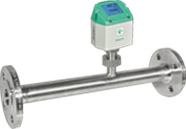
An insertion probe is efficient on a large header, particularly when one sensor length can cover several pipe sizes. On smaller branches, however, correct probe depth and an undisturbed profile may be difficult to achieve. An inline assembly provides a defined internal measuring section and can be installed as a spool in the branch. This is useful behind a machine maintenance unit, at a nitrogen user, or at a departmental take-off where repeatable branch data matters.
The trade-off is mechanical work. The line must be isolated and depressurised for installation, connection size and thread or flange standard must match, and the selected body becomes part of the pressure boundary. Pressure drop, service access, flow direction, and the weight of connected pipework all belong in the design review.
VA 520: flexibility for demanding branch duties
The VA 520 family covers inline measuring sections across a range of connection sizes and is intended for compressed air and suitable gases. Manufacturer information highlights stainless-steel measuring sections, high measuring accuracy into the lower range, selectable units, local diagnostics, and interface options that can include Modbus RTU, 4-20 mA, pulse, and—depending on configuration—other digital networking choices.
That combination suits a utility branch where material selection, pressure rating, diagnostic access, or interface choice needs more flexibility. It may also be the appropriate step when the point is more than a simple machine counter and will become part of a plant energy-management or building-management architecture. Final capability depends on the exact order code, so the bill of materials should state the connection, pressure and temperature limits, gas, display, output, and required accessories rather than only “VA 520”.
VA 525: compact metering for many consumers
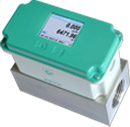
The VA 525 is designed around a small inline measuring block and is particularly relevant when many compressed-air or nitrogen consumers must be connected to an energy-monitoring network. Its compact format is useful close to individual machines, including positions downstream of a maintenance unit where space is limited. Integrated flow conditioning is available across most sizes, reducing the straight-run burden, but the manufacturer’s exception and installation instructions still need to be checked for the selected connection.
Its focused design does not make it a universal lower-cost substitute. The maximum pressure and temperature envelope, wetted materials, gas compatibility, connection size, and network interface must match the point. A plant with one demanding utility branch may reasonably choose a VA 520; a plant building a repeatable machine-metering standard may find the VA 525 architecture more practical.
Use a selection worksheet instead of a model nickname
Before requesting a meter, we ask the plant to complete a short data sheet. It prevents the most common error: selecting on nominal pipe size while leaving the flow range and operating conditions unknown.
- Medium: compressed air, nitrogen, or another approved gas, including expected composition and contamination.
- Operating envelope: minimum, normal, and maximum flow; pressure; temperature; and whether reverse flow can occur.
- Mechanical connection: actual thread or flange standard, available face-to-face space, pipe support, and isolation arrangement.
- Measurement purpose: leakage baseline, cost allocation, machine efficiency, maintenance alarm, or production consumption.
- Outputs: local display, pulse total, analog signal, Modbus, Ethernet-related option, or another approved interface.
- Environment: indoor or outdoor location, washdown, ambient heat, vibration, electrical noise, and enclosure expectations.
Plan the network before multiplying meters
One Modbus meter is simple; forty meters require architecture. Define device addressing, cable type, polarity, shielding, segment length, termination, biasing, gateway location, and polling rate. Keep an address schedule linked to physical tags. If pulse outputs are used, confirm pulse weight and the behaviour of the receiving input during power loss. If 4-20 mA is selected, document range, units, and low-flow cut-off at both ends.
Trend data should preserve the machine state. A flow profile is far easier to interpret when run, idle, fault, and product counters are available from the control system. Without context, a normal cleaning blow may look like waste and a leaking isolation valve may look like an idle process requirement.
Installation and commissioning checks
- Verify the exact meter order code and pressure rating against the approved datasheet.
- Isolate, depressurise, drain if necessary, and apply the plant’s lockout procedure before opening the line.
- Install in the marked flow direction without forcing misaligned pipework through the meter body.
- Use the required upstream and downstream arrangement, even where an integrated straightener reduces inlet-run needs.
- Configure gas, reference conditions, units, output scaling, pulse weight, and communication address.
- Leak-test the mechanical connections, then compare local values with the PLC, logger, or energy platform.
- Observe at idle, normal load, and a representative peak; investigate values that conflict with machine behaviour.
For a networked rollout, commission a pilot group before ordering every point. The pilot confirms cabinet space, gateway loading, naming conventions, dashboard intervals, and whether maintenance can safely remove a meter. It is an engineering validation, not a fabricated promise of savings.
Keep branch data comparable
Cost allocation fails if meters use different reference temperatures, pressures, or units. Lock a plant standard and record it in the tag database. Align totaliser reset rules and time zones. Decide whether a meter total is lifetime, financial-period, or batch-specific, and never reset a value without preserving the prior reading.
Meter health also needs ownership. A stuck value, impossible negative total, communications dropout, or sudden zero during production should create a data-quality flag, not an automatic conclusion about the process. Periodic plausibility checks and calibration planning keep a large meter network credible.
How JAMS supports the choice
Our measuring-technology team reviews the duty point, mechanical arrangement, gas, outputs, and integration before recommending a configuration. The CS Instruments authorisation section describes the manufacturer relationship behind genuine supply and local technical support in Pakistan. A clear enquiry includes the completed selection worksheet and photos or a dimensioned sketch of the proposed location.
Frequently asked questions
Is the VA 525 simply a smaller VA 520?
No. Both are inline thermal consumption meters, but their mechanical construction, operating envelopes, material options, and intended deployment differ. VA 525 is strongly suited to compact machine-consumer networks; VA 520 offers broader choices for more demanding branch applications. Compare exact datasheets and order codes.
Do inline meters need straight pipe?
The required arrangement depends on the model, size, and upstream disturbance. Integrated measuring sections and flow straighteners can reduce uncertainty, but they do not permit arbitrary installation. Follow the manufacturer’s instructions for the selected configuration.
Can the same meter measure compressed air and nitrogen?
Thermal meters can support specified gases when correctly configured, but gas properties affect the result. Confirm that the selected model supports the gas, set the correct gas data, and do not assume a calibration for one medium is valid for every mixture.
Which output is best for many machine meters?
A digital bus can reduce analog input count and carry multiple values and diagnostics, but it requires disciplined network design. Pulse is simple for totals; 4-20 mA is familiar for live flow. The best choice depends on existing PLC hardware, cable routes, update rate, and maintenance capability.