A flow meter should be selected from the fluid and operating envelope, not from the engineer’s favourite measuring principle. Steam density changes with pressure and temperature. A mixed gas may not keep the thermal properties assumed by a thermal mass sensor. A liquid may be non-conductive, ruling out a conventional magnetic meter. These are situations where vortex measurement deserves a careful look.
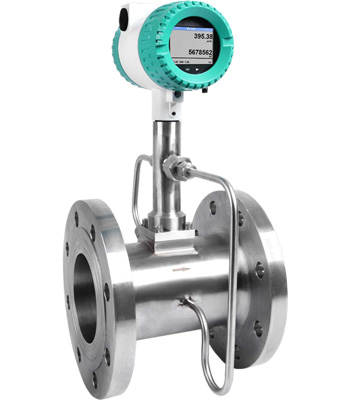
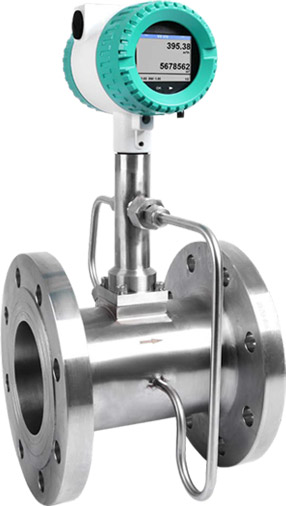
The VX 570 vortex flow sensor from CS Instruments is designed for single-phase gases, mixed gases, saturated or superheated steam, and liquids within its specified range. Integrated pressure and temperature measurement can support operating volume, standard volume, or mass-flow calculations. That breadth is useful, but every installed meter must still be configured and sized for one declared process duty.
How vortex shedding becomes a flow signal
Inside a vortex meter, a bluff body creates alternating vortices as fluid passes. Within the valid Reynolds-number and velocity range, the shedding frequency relates to flow velocity. The sensor detects that frequency and the electronics calculate flow using the meter geometry and configured medium. There are no turbines or bearings in the measuring path.
Vibration is an obvious concern in Pakistani process plants with pumps, compressors, and heavy rotating equipment. The VX 570 uses reference vibration measurement to help distinguish pipe vibration from the vortex signal. This is a design advantage, not permission to ignore supports, resonance, two-phase flow, or severe pulsation. A stable mechanical installation remains part of measurement quality.
Steam: density compensation is part of the job
For saturated steam, pressure or temperature can be used with the appropriate steam relationship to derive density. For superheated steam, both pressure and temperature are relevant. An integrated measurement package reduces separate field devices and wiring, but the design must correctly identify the steam state, pressure range, temperature class, flange rating, insulation details, and expected minimum and maximum mass flow.
Low flow deserves special attention. Vortex meters need sufficient velocity and Reynolds number to form a dependable vortex street. Selecting a meter at line size without checking the actual turndown can leave weekend or low-production steam below the useful measuring range. Reducing the meter size may improve low-flow performance but introduces pressure-drop and piping considerations. We calculate the range before approving the connection size.
Liquids: check conductivity less, check phase more
A vortex meter does not require an electrically conductive liquid, so it can be considered where a magnetic flow meter is unsuitable. The liquid should be compatible with wetted materials and remain primarily single phase through the meter. Entrained gas, flashing, cavitation, or an incompletely filled pipe can destabilise the reading.
Review vapour pressure, process pressure, temperature, viscosity, solids, and the likelihood of deposits. The control valve location can matter: placing a valve where it causes flashing immediately upstream of the meter is poor practice. For horizontal liquid lines, the meter should stay full; for vertical lines, flow direction and process pressure must support a filled measuring section.
Gases and changing compositions
Thermal mass measurement depends strongly on the gas’s thermal properties. Where the composition is unknown or varies, that dependency can create uncertainty. Vortex velocity measurement is less directly tied to those thermal properties, making it a candidate for mixed or changing gases. Integrated pressure and temperature then support conversion from operating volume to a stated reference volume or mass using the configured density model.
“Changing gas mix” does not mean composition never matters. Density and compressibility are still needed for mass or standard-volume calculation. If composition moves enough to change those properties materially, the configured calculation must be reviewed or an external composition input may be required. The process engineer should state the expected composition envelope instead of listing only “gas”.
Build the application data sheet
- Medium and phase: steam condition, gas composition range, or liquid identity, including contamination and corrosivity.
- Flow range: minimum, normal, and maximum operating flow—not only pipe design capacity.
- Pressure and temperature: normal values, start-up transients, design limits, and required connection class.
- Pipe: nominal size, schedule or internal diameter, material, orientation, and available straight lengths.
- Disturbances: bends, valves, reducers, pumps, compressors, pulsation, vibration, and nearby branch entries.
- Required result: operating volume, standard volume, mass flow, total, pressure, temperature, and output update rate.
- Integration: local display and required analog or Modbus signals, cable distance, power, and control-system mapping.
The manufacturer lists wafer and flanged arrangements across defined sizes and ratings. Selection must align the process connection, pressure class, temperature option, wetted material treatment, output package, and reference conditions. “VX 570, DN50” is not a complete procurement description.
Installation details that protect accuracy
Provide the specified straight runs and keep major disturbances outside them. Use correctly sized gaskets that do not intrude into the bore. Align the meter, support adjacent pipework, and avoid transferring excessive nozzle load into the body. For steam, follow accepted condensate, insulation, warm-up, and personnel-protection practices. For hot service, make sure electronics and cabling remain within their allowed ambient conditions.
Grounding, shielding, and signal separation should follow the electrical instructions. Configure engineering units and reference conditions identically at the sensor and receiving system. During commissioning, compare indicated pressure and temperature with credible plant references, verify flow direction and totalisation, and observe the signal through low, normal, and high operating states.
Choose vortex for the right reason
Vortex is attractive for high-temperature steam, suitable liquids, and mixed gases, but it is not the answer to every line. Thermal mass may provide a better low-flow span for clean compressed air of known composition. Magnetic flow may be excellent for conductive water with a full pipe. Coriolis may be justified where direct mass and density performance outweigh cost and pressure drop. Differential pressure remains practical in many established standards.
At JAMS, the recommendation follows the process data and the decision the measurement must support. Our measuring-technology service covers meter selection and integration, while our CS Instruments authorisation information provides the supply context for Pakistan. Share the application sheet early, before piping is frozen.
Frequently asked questions
Can one VX 570 be moved between steam, gas, and liquid services?
The product family supports those media, but a specific meter is ordered and configured for a defined duty, connection, pressure, temperature, and calculation. Moving it between unrelated services without engineering review, reconfiguration, and appropriate mechanical work is not a sound measurement strategy.
Why is minimum flow so important for vortex meters?
A stable vortex signal requires sufficient velocity and Reynolds number. If the meter is sized only for maximum flow, low-load operation may fall below its useful range. Correct sizing balances low-flow visibility, peak capacity, pressure drop, and connection constraints.
Can VX 570 measure wet steam or two-phase liquid?
The stated applications are primarily single-phase media and correctly defined steam conditions. Significant liquid carryover, entrained gas, flashing, or other two-phase behaviour can affect vortex measurement. The process condition should be corrected or reviewed before selection.
Does integrated compensation remove the need for process data?
No. Pressure and temperature sensors provide important inputs, but the meter still needs the correct medium model, reference conditions, range, and installation. Compensation improves the calculation; it cannot repair an incorrect application definition.