
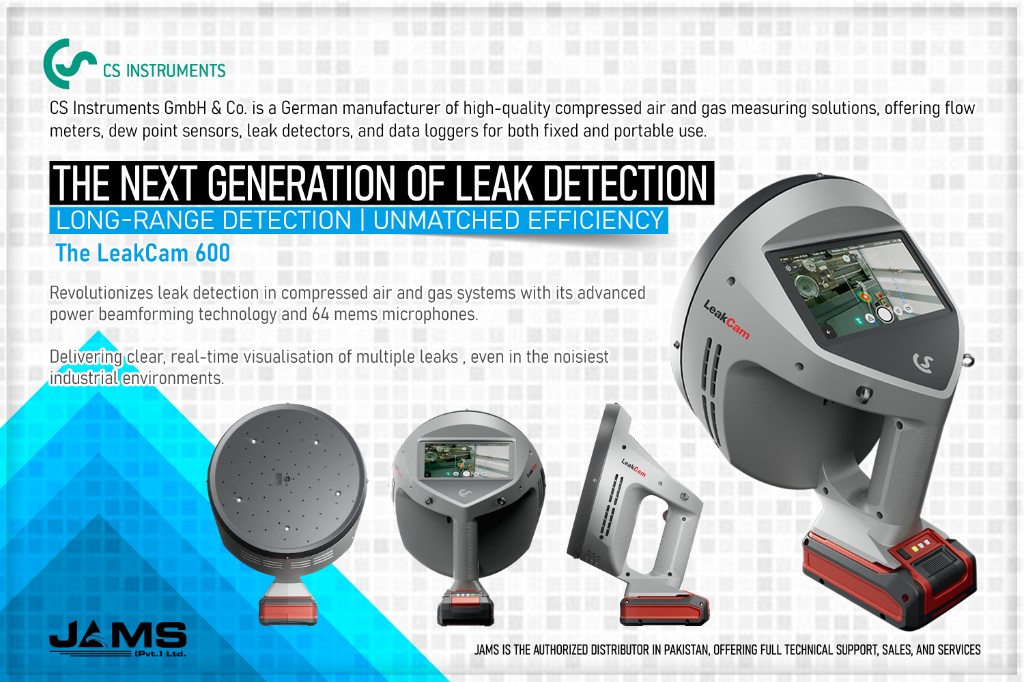
In a running factory, the loudest sound is rarely the leak that matters most. Compressors, pneumatic cylinders, steam traps, bearings, extraction fans, and material handling equipment all compete for attention. A maintenance team walking the line with only its ears can pass within a few metres of a costly compressed-air leak and never notice it. The practical value of acoustic imaging is that it turns otherwise invisible ultrasonic energy into a location on a live image, allowing the surveyor to separate a likely leak from the general noise of production.
At Jams (Pvt.) Ltd, we treat the LeakCam 600 as a survey instrument, not a magic camera. Its results become useful when the route, operating conditions, tagging method, and repair process have been planned before anyone starts scanning. That distinction matters in Pakistan, where a survey may need to cover several compressor houses, textile halls, packaging lines, or process units without interrupting production.
Why conventional listening becomes difficult
A compressed-air leak creates turbulence as pressurised gas passes through a small opening. Part of that energy lies above the range of normal human hearing. Handheld ultrasonic detectors use this fact effectively, especially when a technician can approach the fitting and confirm the source. The difficulty comes in a crowded or inaccessible area: there may be several ultrasonic sources, the suspected joint may be overhead, and the production line may not permit a slow point-by-point search.
Acoustic imaging adds spatial information. The LeakCam 600 uses an array of 64 ultrasonic MEMS microphones and a power-beamforming algorithm to locate acoustic sources and overlay them on the camera view. Multiple sources can be shown at the same time, which is valuable around valve manifolds, filter-regulator-lubricator assemblies, hose drops, and densely piped machine skids. The surveyor can scan a wider area first, then move closer for identification and documentation.
“Works in noise” does not mean that every bright spot is automatically a compressed-air leak. Pneumatic exhausts, vacuum generators, electrical arcing, rubbing components, and some production processes can also generate ultrasound. An applications engineer still checks whether the indication remains tied to a joint or component, whether it changes with the equipment state, and whether the source is safe to approach.
A field workflow that produces repairable findings
Good surveys begin with a marked-up plant route. We divide the network into logical zones, note pressure levels and shift patterns, and agree how assets will be named. A tag such as “Line 3” is not enough for a fitter returning two weeks later. A useful record identifies the building, level, machine, component, and exact connection. Where production states vary, the record also notes whether the machine was loaded, idle, isolated, or cycling when the leak appeared.
During the walk-down, the operator scans from a safe position, avoids standing in vehicle routes, and works progressively from broad views to close confirmation. The camera should not encourage anyone to ignore plant safety rules or enter a restricted area. A practical sequence is:
- Confirm that the relevant header and machine branch are pressurised under a representative operating state.
- Scan high-level mains, drops, hose reels, valve islands, actuators, quick couplings, and maintenance isolation points.
- Re-scan an indication from another angle where access permits, reducing the chance of confusing a reflection with the source.
- Capture the location and equipment identity, then attach a durable physical tag that matches the digital record.
- Assign a repair category, access requirement, responsible team, and target date before moving the item into the backlog.
This method is part of a wider measuring-technology programme. The camera finds and documents likely losses; fixed flow measurement establishes how the compressed-air system behaves over time. One cannot replace the other.
Prioritise by consequence, not colour alone
An acoustic image helps locate a source, but the maintenance priority should consider more than the visual intensity. Operating pressure, estimated loss, annual running hours, accessibility, safety, process criticality, and the shutdown needed for repair all affect the decision. A modest leak on a continuously pressurised ring main may deserve attention before a larger indication on equipment used for one short batch each week.
We recommend separating findings into quick repairs, planned-shutdown repairs, and engineering modifications. Loose fittings and damaged tubing may be straightforward. A leaking isolation valve, corroded header, or repeatedly failing flexible connection may need permits, replacement design, or root-cause work. The objective is not to produce the biggest possible list; it is to issue a list that the plant can close.
Measure before and after the repair campaign
Leak estimates are useful for ranking, but system-level evidence strengthens the business case. Record main-header or zone flow during stable non-production periods before repairs, then repeat under comparable pressure and operating conditions. If pressure, active machines, or dryer purge state changes, note that difference rather than claiming that every change in flow came from the leak campaign.
The most defensible report contains both layers: itemised acoustic findings and a trend showing whether avoidable baseline demand fell. It should also record open items. A survey is not “complete” because every leak was photographed; it is complete when findings have owners, repairs are verified, and unresolved work remains visible.
Conditions that deserve extra care
- Reflections: hard walls, roofing, and sheet-metal guards can reflect ultrasound. A second viewing angle helps establish the true source.
- Intermittent equipment: cylinders and valves may leak only in one position. Observe a full operating cycle where this can be done safely.
- Pressure variation: leakage changes with pressure. Record the local pressure if findings will be compared across zones or dates.
- Inaccessible height: long-range imaging helps locate overhead sources, but repair planning still requires a safe access method.
- Other gases: suitability, risk controls, and site procedures must be checked before surveying any compressed gas other than ordinary plant air.
Build a programme rather than a one-off event
Compressed-air systems change continuously. Hoses are replaced, machines are moved, seals age, and temporary connections become permanent. A sensible cadence combines routine operator reporting, targeted checks after maintenance, and periodic structured surveys. High-use or high-pressure zones can be revisited more frequently than isolated low-duty branches.
JAMS supports genuine CS Instruments equipment and application guidance in Pakistan; our CS Instruments authorisation information explains that relationship. For a useful scope, share a piping layout, compressor schedule, operating pressures, shift pattern, and the way your plant currently raises maintenance work orders. Those details determine whether the camera will become part of a closed repair loop or simply produce another report.
Frequently asked questions
Can the LeakCam 600 find leaks while production is running?
It is intended for industrial leak detection and acoustic imaging can be especially useful during normal operation, when the system is pressurised. The survey still needs a safe route and representative machine states. Some findings may require confirmation during a quieter period or a different step in the machine cycle.
Does acoustic imaging give an exact energy saving?
It can support evaluation and prioritisation, but an energy-saving claim should also use actual pressure, operating hours, compressor performance, and preferably before-and-after system flow. We avoid converting every indication into a guaranteed rupee value without those inputs.
Will it replace a handheld ultrasonic detector?
Not in every task. Imaging is efficient for broad scans, multiple sources, and hard-to-reach assets. A handheld detector can remain useful for close confirmation and confined locations. The correct tool mix depends on access, plant noise, and the required documentation.
What should the plant prepare before a survey?
Prepare the area list, asset naming convention, safe-access requirements, pressure information, shift schedule, and a person who can explain machine states. Most importantly, nominate who will receive, repair, and verify each tagged finding after the walk-down.